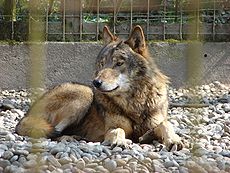
Eastern Wolf
Canis lycaon
About Eastern Wolf
The Eastern Wolf, also known as Eastern Canadian Wolf or Eastern Canadian Red Wolf, may be a subspecies of gray wolf (Canis lupus lycaon), a distinct species of canid (Canis lycaon) or a hybrid species (Canis lupus X Canis latrans) native to the eastern part of North America since the Pleistocene era. It seems to be closely related to the Red Wolf. Some populations have also contained instances of hybridization with Coyotes, known as coywolves.
Many names were proposed, including the Eastern Wolf, Eastern Gray Wolf, Eastern Timber Wolf and Algonquin Wolf, although Eastern Wolf has appeared to gain the most recognition.
Eastern Wolf was recently recognized as a potentially distinct species, but closely related to red wolf.[5] Some authors disagree[6] and the status as a distinct species is not official. Now, many international and government organizations carry out scientific research for their taxonomy and genetics to answer this question, as well as researching their ecology and influence on the ecosystem.
The Eastern Wolf is smaller than the Grey Wolf and has a grey-reddish coat with black hairs covering the back and sides of the thorax. The mtDNA analysis confirms that eastern wolf belonged to an ancient form of primitive wolf (with red wolf) originating some 750,000 years ago in the eastern part of North America (Nowak 1979, 1992). This distribution of haplotypes shows elements similar to the red wolf and probably is a part of this species. Red Wolf populations were extirpated from the wild in the southeastern United States, were reintroduced to the wild in recent decades and are now critically endangered.
The Eastern Wolf mainly occupies the area in and around Algonquin Provincial Park in Ontario, and also ventures into adjacent parts of Quebec, Canada. It also may be present in Minnesota and Manitoba. In the past, this species might have ranged south into the United States, but after the arrival of Europeans, these wolves were heavily persecuted and became extirpated from the United States. In Canada, exact numbers of Eastern Canadian Wolves are unknown.
In Algonquin wolves often travel outside the park boundaries, and enter farm country where some are killed. "Of all the wolf deaths recorded from 1988 to 1999, a minimum of 66% was caused by humans. Shooting and snaring outside park boundaries were the leading causes of death for wolves radio-collared in Algonquin Park". One wolf that was radio-collared in July 1992 was located in October in Gatineau Park (north of Ottawa), which is 170 km from Algonquin Park. By mid-December it had made its way back to Algonquin and then, in March 1993, this wolf's severed head was found nailed to a telephone pole in Round Lake.
Hunting Techniques
Choice of hunting equipment